
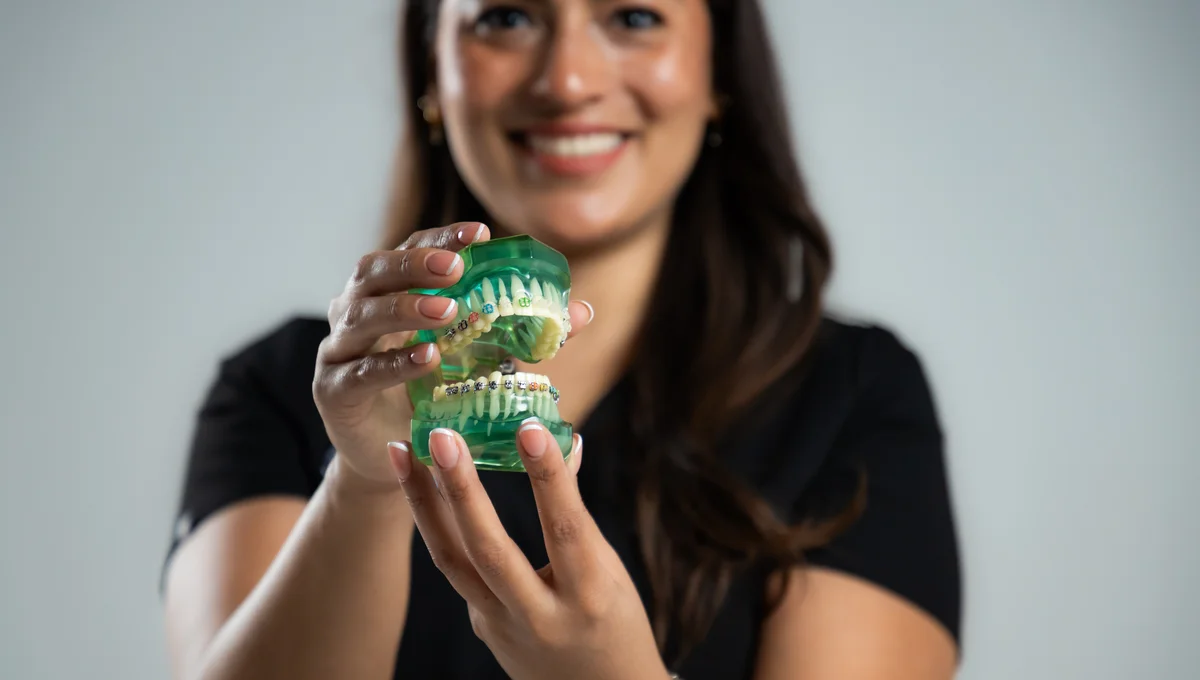
Quick answer: adult orthodontic relapse does not typically require another two years of comprehensive metal braces. If your posterior bite and jaw structure remain stable, minor-to-moderate tooth crowding or spacing is successfully corrected within 4 to 9 months using custom clear aligners (Invisalign®) or aesthetic self-ligating brackets, digitally mapped via 3D iTero Element intraoral scanning and ClinCheck simulations by Dr. Adrianna Oseguera in Mexicali, just 8 minutes from the Calexico West downtown border crossing.
Very few dental experiences are as disheartening as looking in the mirror in your late twenties, thirties, or forties and noticing that the straight, confident smile you achieved during adolescence has begun to shift and crowd again. At our Mexicali practice, located just minutes across the California border, we frequently welcome patients from Imperial Valley (Calexico, El Centro, Brawley), Yuma, and San Diego carrying a heavy sense of frustration: "Doctor, I wore braces for almost three years in high school… why did my teeth move again? Do I really have to start all over from scratch?"
The definitive clinical answer is no. Dental relapse is not a personal failure or an irreversible catastrophe; it is a predictable, biological process that modern digital orthodontics can resolve quickly, discretely, and comfortably without traditional metal wires.
1. The Biological Anatomy of Relapse: 4 Scientific Causes of Late Dental Crowding
To effectively address shifting teeth, it is essential to understand why teeth never remain completely static in the jawbone throughout adulthood:
- 1. Elastic Memory of Supracrestal Transseptal Fibers: The periodontal ligament that suspends each tooth root within the alveolar bone contains collagen fibers. As teeth are realigned during orthodontics, these fibers stretch like microscopic rubber bands. If retainers are discontinued before complete cellular reorganization, these fibers exert constant elastic recoil, pulling teeth back toward their former positions.
- 2. Physiological Mesial Drift: Throughout adulthood, human mastication generates a natural anterior component of force, continuously nudging posterior molars forward toward the midline. This steady force creates cumulative pressure against anterior incisors, resulting in overlapping and crowding.
- 3. Natural Narrowing of the Intercanine Arch Width: As the human craniofacial complex matures, the transverse distance between lower canines naturally constricts. When this space decreases, the four lower incisors are forced into progressive crowding.
- 4. Are Wisdom Teeth (Third Molars) Solely to Blame? Modern orthodontic literature has debunked the persistent myth that erupting third molars are solely responsible for anterior crowding. Studies confirm that patients with congenital absence or early extraction of wisdom teeth experience nearly identical rates of anterior crowding, proving that mesial drift and retainer abandonment are the true primary culprits.
2. Conquering the Number-One Fear: You Do Not Need Another 2 or 3 Years of Metal Braces
The single greatest hurdle keeping adult professionals from fixing shifted teeth is the dread of repeating the multi-year adolescent experience: conspicuous metal brackets, frequent emergency visits for broken wires, and mouth sores.
Here is the crucial clinical distinction: an orthodontic retreatment for relapse is NOT a comprehensive initial orthodontic case. Teenage orthodontics requires 18 to 30 months because it must guide jaw growth, expand skeletal palates, and correct major bite discrepancies. In an adult with minor-to-moderate relapse, your posterior bite relationship is almost always stable. We are strictly performing targeted anterior realignment, which typically takes only 4 to 9 months with modern clear aligner technology.
| Retreatment Modality | Estimated Duration | Aesthetic Discretion | Appointment Cadence | Primary Clinical Indication |
|---|---|---|---|---|
| Clear Aligners (Invisalign®) | 4 to 9 months | Maximum: Virtually invisible at standard conversational distance | Every 8 to 10 weeks (batch dispensing) | Adults and professionals with mild-to-moderate relapse; unrestricted oral hygiene and dietary freedom. |
| Aesthetic Passive Self-Ligating Brackets | 6 to 12 months | High: Clear sapphire or ceramic without rubber elastics | Every 8 weeks (continuous thermal wires) | Moderate relapse requiring complex root torque or significant tooth rotation. |
| Fabricating a Replacement Retainer Alone | Immediate (no realignment) | Variable | 1 or 2 visits | Stops further shifting only. CANNOT re-straighten shifted teeth; forcing a tight tray risks root resorption. |
| Post-Retreatment Fixed Lingual Wire | Permanent stabilization | 100% invisible: Bonded behind front teeth | Routine semi-annual checkups | Guarantees 24/7 stability on lower incisors, ensuring you never need orthodontic retreatment a third time. |
3. 3D Digital Intraoral Scanning with iTero Element®: Preview Your Results Before Starting
Bid farewell to gooey impression trays that trigger gag reflexes. Our clinic utilizes the iTero Element 3D intraoral scanner, capturing thousands of optical frames per second to construct an exact digital model of your teeth in under five minutes.
Through proprietary ClinCheck® software, Dr. Adrianna Oseguera maps out the exact stage-by-stage tooth movements. During your initial consultation, you can view an interactive 3D simulation on our monitor showing precisely how your crowding will resolve before any aligners are manufactured.
Clinical Warning: Never Force an Old Retainer that Does Not Seat
If your old retainer no longer snaps down completely, NEVER bite down forcefully to jam it into place. Uncontrolled mechanical forces applied to misaligned roots cause periodontal ligament ischemia, severe tooth pain, pulpal necrosis, and irreversible root shortening. If it does not seat with light finger pressure, a professional evaluation is essential.
4. Clinical Relapse Triage: What to Do When You Notice Teeth Shifting
If you notice your teeth shifting out of place, follow this orthodontic triage protocol before making any decisions:
- Step 1: Gentle Finger Seating Test: Insert your retainer using finger pressure only. If it snaps down completely flush without acute pain, wear it nightly to stabilize positions.
- Step 2: If It Rocks or Fails to Seat: Discontinue wear immediately. This indicates your teeth have migrated past the tray's elastic tolerance. Forcing it will only cause root trauma.
- Step 3: Precision 3D Digital Assessment: Schedule a consultation to determine if an express 4 to 6 month clear aligner protocol is the optimal path forward. The earlier relapse is addressed, the faster and simpler treatment remains.
5. Cross-Border Care: Convenient Appointments for California & Arizona Commuters
Our clinic is conveniently located at Av. República de Brasil #499-3, Col. Cuauhtémoc Norte, exactly 8 minutes walking distance (or 5 minutes by car) from the Calexico West Port of Entry (Downtown Border Crossing).
For our patients commuting from Imperial Valley (Calexico, El Centro, Brawley), Yuma, and San Diego, our digital treatment workflow is designed for maximum efficiency: we provide multiple sets of custom aligners in advance, spacing checkups every 8 to 10 weeks to seamlessly accommodate your work schedule.
6. The Permanent Retention Protocol: How to Never Need Braces a Third Time
Our clinical objective is not simply to realign your teeth in record time, but to ensure that you never need orthodontic care again. We achieve this through our Dual Long-Term Stability Protocol:
- Bonded Fixed Lingual Wire (Lower Arch): An ultra-thin braided biocompatible wire cemented behind the lower front 6 teeth. It is 100% invisible, does not interfere with speech, and provides 24/7 protection against crowding relapse.
- Upper Removable Clear Retainer (Vivera®): Milled from your final 3D digital file for nighttime-only wear, preserving upper arch width and smile symmetry.
- Secure Cloud Archive: Your final 3D scan remains permanently stored on our servers. If you ever lose a removable retainer, we can reproduce a replacement directly without repeating impressions.
7. Frequently Asked Questions (FAQ)
Will my teeth move faster the second time around?
Generally yes. Alveolar bone that has previously undergone orthodontic remodeling responds readily to light, continuous physiological forces, and adult retreatment primarily involves localized tipping and alignment rather than complex skeletal corrections.
Can I get clear aligners on just my lower teeth if the top teeth haven't shifted?
A comprehensive orthodontic examination always evaluates both arches. Even if crowding is only noticeable on the bottom, upper aligners are typically necessary to coordinate the bite and ensure the newly aligned lower teeth do not collide with the upper incisors.
Do I have to extract my wisdom teeth before fixing my relapse?
Not necessarily. Dr. Adrianna Oseguera evaluates panoramic X-rays to verify whether third molars pose an active biological threat or impede movement before making any extraction recommendations.
Why does orthodontic relapse almost always hit the lower front teeth first?
Due to the convergence of two biological factors: the natural reduction of the lower intercanine width over time and continuous mesial chewing forces that push rear molars forward, concentrating pressure on the delicate anterior teeth.
Will clear aligners be noticeable during business presentations or social events?
No. Invisalign aligners are manufactured from proprietary medical-grade SmartTrack material and trimmed precisely along your gumline, rendering them virtually invisible at standard conversational distance.
If I completed braces in the United States years ago, can I receive retreatment in Mexicali?
Yes. Many of our patients completed their adolescent treatment in California or Arizona and cross to our Mexicali practice for digital retreatment, taking advantage of our convenient location just an 8-minute walk from the Calexico border.