
See your teeth in 3D on screen in a few minutes. Dr. Adrianna Oseguera uses the iTero scanner as the starting point for Invisalign, braces, retainers and orthodontic appliances, 8 minutes from the Calexico border.
An iTero scan is a digital impression of your teeth and gums taken with a small handheld wand instead of trays filled with putty. The wand uses light to capture the shape of your teeth, and software builds a 3D model of your bite on screen within a few minutes. At Dr. Adrianna Oseguera's clinic in Mexicali, this scan is the starting point for Invisalign, braces, retainers and orthodontic appliances.
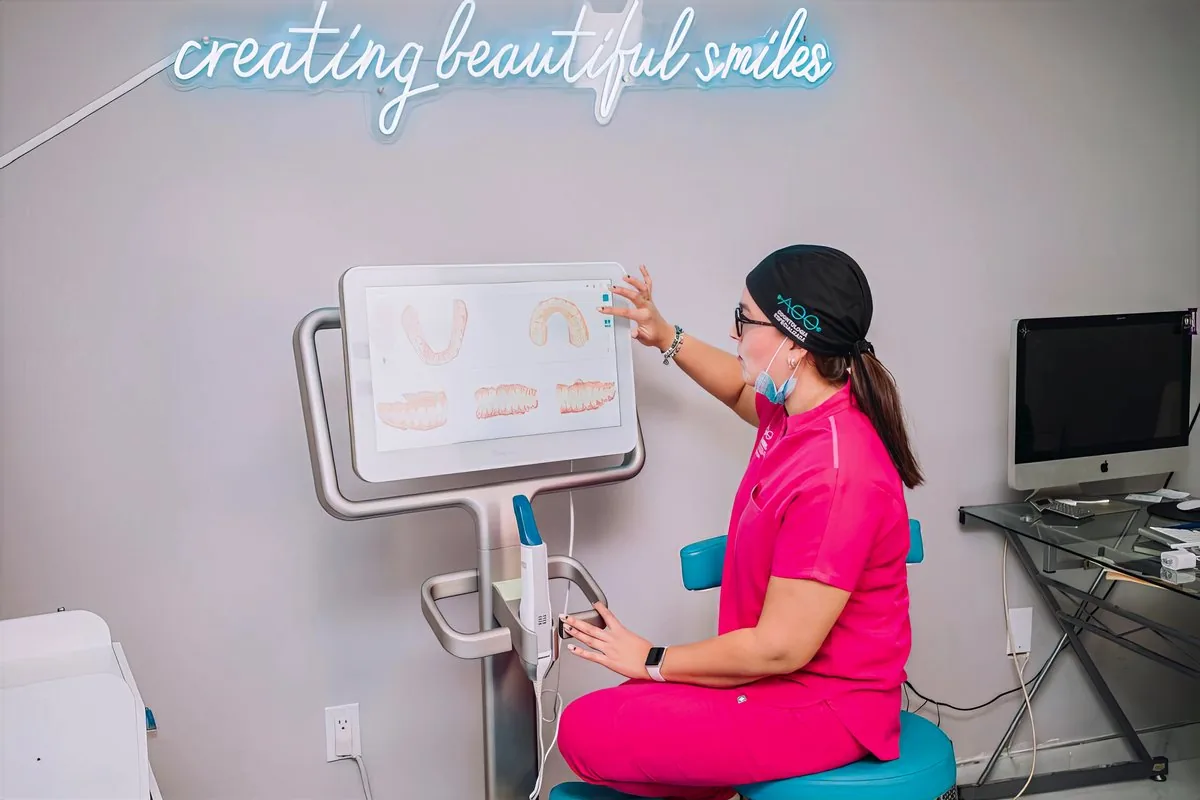
iTero is an intraoral scanner made by Align Technology, the same company that makes Invisalign. Instead of taking a physical mold, the clinician passes a slim wand over your teeth. The scanner records the surface of your teeth and gums, and the software stitches those images into a detailed 3D model that you can see on the screen right away.
The scan itself uses light, not X-rays. If your orthodontist needs X-rays to diagnose your case, those are a separate step and are only taken when they are clinically useful.
Traditional impressions use a tray filled with putty or alginate that sits against your teeth until the material sets. A digital scan replaces that step. Here is how they compare:
| iTero digital scan | Traditional impressions | |
|---|---|---|
| Comfort | No tray or putty in your mouth. A small wand moves across your teeth. | A tray filled with material is held in place until it sets. |
| Gag reflex | Often easier for patients who gag easily, because there is no bulky tray. | Bulky trays can trigger gagging in some patients. |
| Time | Usually a few minutes for both arches and your bite. | Material needs time to set, and the process can take longer. |
| Seeing the result | The 3D model appears on screen immediately, so you can see your own teeth with the doctor. | A physical model is poured later, and you do not see it during the visit. |
| Retakes | If an area is missed, that area can often be rescanned. | A poor impression usually has to be repeated in full. |
| The file | Saved as a digital record that can be used for treatment planning and for comparing progress over time. | A plaster model that must be stored or shipped. |
Dr. Oseguera asks what you would like to improve and reviews any previous orthodontic treatment, so the scan has a clear purpose.
The wand is moved over your upper teeth, your lower teeth and then your bite. You do not need to hold a tray or keep still for the material to set.
The 3D model builds as the scan progresses. If an area needs another pass, the clinician can rescan it right away.
Dr. Oseguera shows you what she sees, such as crowding, spacing or how your upper and lower teeth meet, and explains the treatment options that fit your case.
Adults, teenagers and children can all have an intraoral scan, as long as they can comfortably keep their mouth open for a short time. Children are often first evaluated around age 7, when the first permanent teeth appear. Whether a scan is needed at that age depends on the child and on what Dr. Oseguera finds during the exam, so it is her decision after the evaluation and not an automatic step for everyone.
Your first appointment is a consultation, and the scan is one part of it. To make the visit more useful:
After the scan and exam, Dr. Oseguera explains whether Invisalign, braces or another approach suits you. Some cases also need X-rays or photos, and she will tell you if yours does.
Yes. The scan is done during your consultation, so cross-border patients can start planning in a single visit. The clinic is about 8 minutes from the Calexico West Port of Entry. See our guide for patients crossing from Calexico and our border crossing guide for directions and tips. If you live farther away, for example in Phoenix or Las Vegas, ask about remote monitoring for Invisalign.
Dr. Adrianna Oseguera earned her dental surgery degree at the Universidad Autonoma de Baja California (UABC). Professional License: 8556217.
Specialty in Orthodontics and Dentofacial Orthopedics at the Universidad De La Salle Bajio. Specialty License: 11410417.
Certified Invisalign Doctor, recognized by Align Technology.
Her licenses can be checked in Mexico's national registry of professionals. The clinic is at Av. Republica de Brasil #499-3, Colonia Cuauhtemoc Norte, Mexicali, B.C.
Most patients find it comfortable, because there is no tray or putty in the mouth. People with very sensitive teeth or limited jaw opening may notice some discomfort, so tell the team beforehand and they can adjust.
The scan of your upper teeth, lower teeth and bite usually takes a few minutes. The full appointment is longer because it also includes your consultation and review of the results.
No. The scanner captures the shape of your teeth and gums with light. X-rays are a separate diagnostic tool and are only taken when your orthodontist considers them necessary for your case.
In many cases the scan allows Dr. Oseguera to show a simulation of the projected movement of your teeth. It is a projection to help you understand the plan and is not a guarantee of the final result.
The scan is one part of a full evaluation. Dr. Oseguera also examines you and may use photos or X-rays depending on your case before recommending a treatment plan.
Yes. The scan is part of your consultation, so you can have it during a single trip. The clinic is about 8 minutes from the Calexico West Port of Entry, and remote monitoring may be an option for some Invisalign patients who live farther away.
Message us on WhatsApp or book online. Our bilingual team will explain what to expect before you cross the border.
Book via WhatsApp: +52 (686) 140-9235Specialist orthodontic care with Dr. Adrianna Oseguera in Mexicali, B.C.
Fill out this quick form and we will confirm availability in minutes.
Convenient access in Col. Cuauhtemoc Norte, Mexicali.